
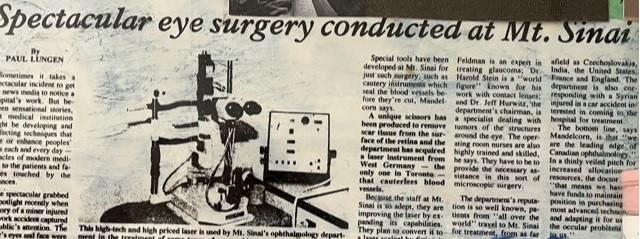
Prior to 1972, there was no safe and effective way of performing any form of endoscopic surgery. The concept of endoscopic surgery was not yet known. As Senior Resident in the Ophthalmology residency training program at the University of Toronto in 1972, Dr. Mandelcorn heard about the work of Dr. Machemer and contacted Dr. Machemer to offer to become his Fellow to assist him in developing this surgical technique and instrumentation.
Figure 1 Toronto Globe and Mail, September 1974
For 2 years from 1972-74, they worked together on instrumentation, surgical indications, medical publications, educational seminars, and hands-on wet labs and other formats to introduce to retina surgeons from all over the world this exciting and revolutionary procedure.
During these 2 formative years from 1972-1974, nearly all the instrumentation challenges were met, suitable surgical cases were identified, and early results were compiled and later published which completely changed the scope of ophthalmic surgery. Today, retina surgeons around the world perform 95% of retina surgery using vitrectomy concepts and techniques that were developed during the 2 years from 1972-4 that Dr. Mandelcorn spent working with Dr. Machemer.
As one of the pioneers in the development of this technique, Dr. Mandelcorn became the second retina surgeon in the world (the first was his mentor, Dr. Robert Machemer) and the first in Canada to perform vitrectomy surgery. He remained the most prominent Canadian resource in this area for many years up to and including the present.
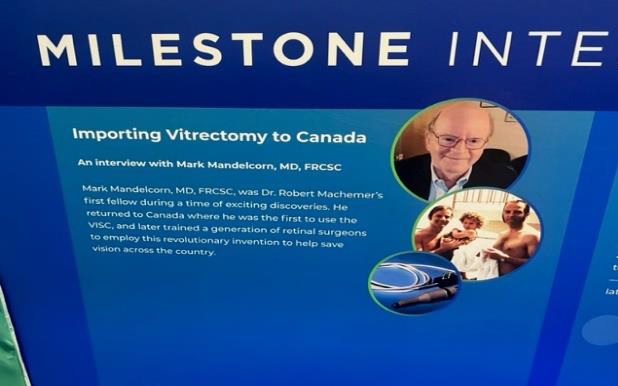
During the period following his return to the University of Toronto in 1974, Dr. Mandelcorn taught many practising Retina surgeons from Canada and around the world, as well as other specialists in Medicine and Surgery, including residents, fellows and medical students, in how to make use of vitrectomy in the management of what had previously been considered to be incurable blindness. Dr. Mandelcorn’s early publications in peer-reviewed journals were instrumental in making Canada and Toronto in particular the destination centre for difficult retina surgical referrals from around the world.
His work at the University of Toronto in restoring sight to blind diabetics began with his first diabetic surgical patient in 1974 referred to the University of Toronto from the Middle East who had been blind for 20 years and who, on the first morning after his vitrectomy operation, was able to see his daughter and granddaughter for the first time in 20 years.